Popping bubbles

Artificial intelligence is a term we hear more and more. This emerging technology shows great potential and seems to have an unlimited number of applications. One of these applications is personalization.
Whether it’s an online ad, your Netflix or Spotify recommendations or even your favorite news site, everything is becoming personalized. This sounds great, but is it really?
Current events in society, such as the capital attack in the US and the curfew riots in Eindhoven and other Dutch cities, show the downside of personalization. And specifically, the downside of personalization of social media feeds. Namely, polarization

Through recommender systems, people get trapped in a filter bubble in which they only get one-sided information. And this information is repeated an enormous number of times. Due to this a common understanding of what is true and what is false is disappearing. Moreover, there is no common reality anymore. Imagine what this technology can do in the future if this trend pursues. Films and series could become personalized, news broadcastings, sport matches, education, and much more.

This would result in a multitude of realities, no common nostalgia between groups, no unexpected moments of serendipity to discover new things or new worldviews. This is what causes polarization in society as it’s becoming more difficult for people to understand each other.

Concept

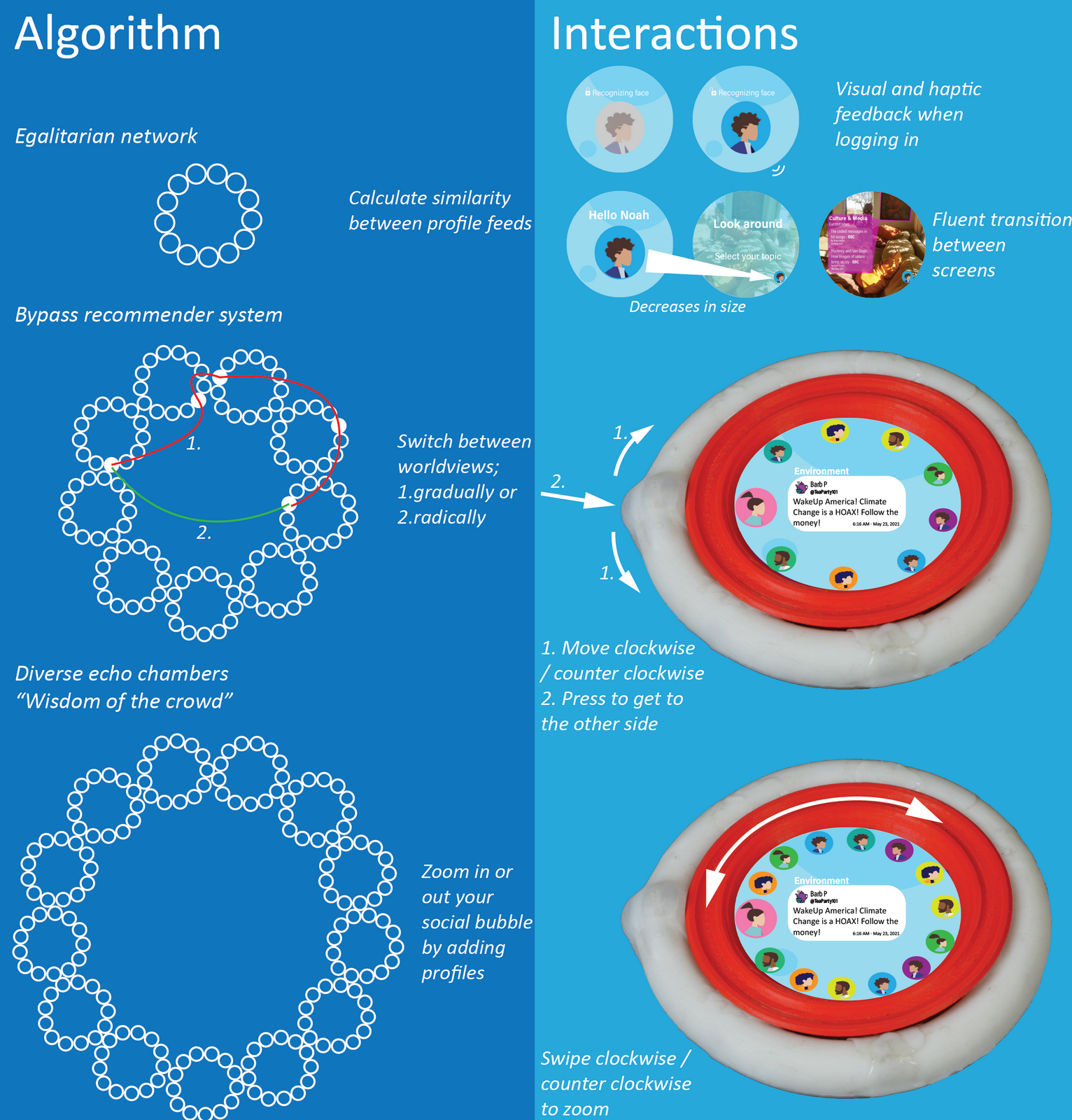
This project aims to encounter polarization in society by breaking through social media filter bubbles. Popping Bubbles helps you to break free from your filter bubble and has the goal to increase the users understanding of worldviews that differ from theirs. This is done by allowing you to explore what kind of content is consumed by someone with a different worldview.
By identifying the causes of polarization due to social networks and finding ways to get around them, polarization could be reduced. The project focuses on solving the problems of 1) Social network homophily (recommender systems), 2) Echo chambers and 3) Centralized networks (influencers). A machine learning algorithm was developed that focuses on creating intergroup contact, wisdom of the crowd and egalitarian networks.

Digital prototype

As this project took place during a covid lockdown it was not possible to perform physical usertests. Therefore, a digital prototype was created to evaluate the concept. 

Click on the image to expand